Tank storage for petroleum products
A tank looks like a simple steel cylinder. Choosing the right one depends on what is going in it, how long it will stay and how it will leave.
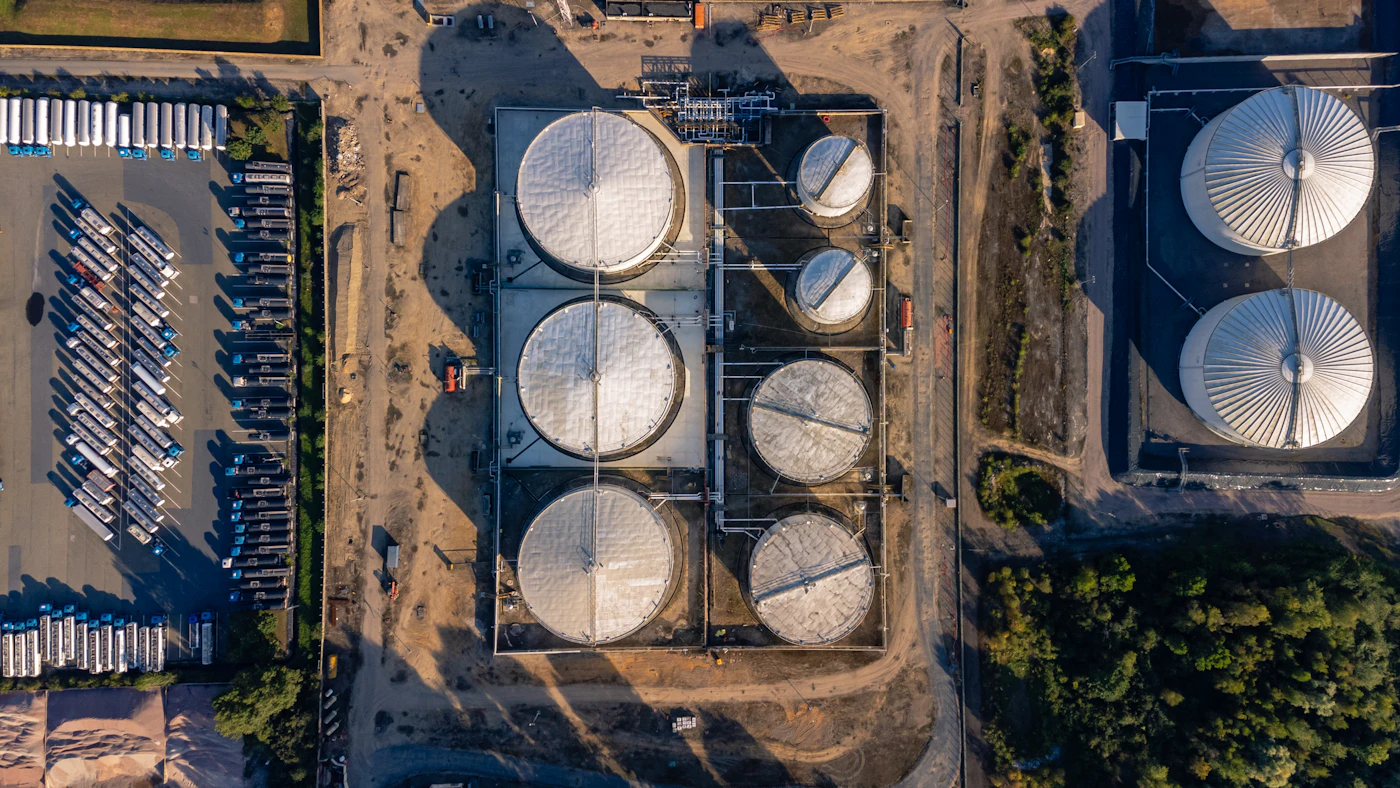
Four tank types in section
Red marks the part that manages the product's main risk: a floating deck for vapor, coils for viscosity. A plain cone roof has neither.
External floating roof
A steel deck floats directly on the product with a seal at the shell, leaving almost no vapor space. Rain and snow have to be drained off the deck.
Typical use: gasoline and other volatile products in large volumes
Internal floating roof
A light floating deck sits under a fixed roof. It controls vapor like an external floater and also keeps weather out, which helps protect product quality.
Typical use: gasoline, ethanol and blends, jet fuel
Fixed cone roof
The simplest design. The space above the liquid fills with vapor that vents as the tank fills and in warm weather. That is acceptable only for lower-volatility products.
Typical use: diesel, heating oil, some fuel oils
Heated and insulated
Steam or thermal oil coils near the floor, with insulation on the shell, keep heavy product warm enough to pump. Overheating wastes energy and can damage the product.
Typical use: heavy fuel oil, bitumen, some residues
What each product demands
Typical values. A tank suited to diesel can be entirely wrong for gasoline, and a change of service often means cleaning, inspection and new permits.
| Product | Density, kg/L | Flash point | Storage concern |
|---|---|---|---|
| Gasoline | 0.72 to 0.78 | About −40°C | Evaporation and vapor control. Summer and winter grades differ. Stability declines over time. |
| Gasoline with ethanol | 0.74 to 0.78 | Below −20°C | Ethanol takes up water, and enough water causes phase separation. Often blended at the truck rack. |
| Jet fuel | 0.775 to 0.84 | 38°C minimum | Tight cleanliness standards. Needs dedicated handling, filtration and a documented chain of quality. |
| Diesel | 0.82 to 0.86 | 52°C minimum | Water at the tank floor encourages microbial growth. Cloud point matters in cold weather. |
| Heating oil | 0.82 to 0.88 | About 38°C minimum | Generally stable, but sulfur limits differ by state, and grades must be kept separate. |
| Heavy fuel oil | 0.92 to 1.01 | 60°C minimum | Needs heating. Blends can be incompatible, causing sludge. Hydrogen sulfide can build up in the headspace. |
Shell capacity is not what you can use
Ask for a tank's working capacity in writing, along with its heel and safe-fill levels.
A tank's advertised capacity is often its shell or nominal volume. You cannot use all of it. A heel stays below the pump suction, and space is kept at the top for safe filling and for the floating roof's landing limits. Storage fees, however, are often charged on the contracted shell capacity.
Working capacity calculator
Enter a tank's dimensions to estimate its usable volume.
- Shell, barrels
- -
- Shell, m³
- -
- Working, barrels
- -
- Share usable
- -

Keeping product on specification
Water
Water finds its way into most tanks, through condensation, roof seals or the cargo itself. It settles at the bottom and is drawn off routinely. If left there, it can support the microbes that clog diesel filters.
Segregation
A small amount of gasoline in diesel can lower its flash point below the legal limit, turning a whole tank into a costly downgrade. Line-ups, line flushing and sealed valves all exist to prevent this.
Change of service
Moving a tank to a new grade may require draining, gas-freeing, cleaning and inspection. The cost and time depend on the old and new products, and going from heavy to light is the hardest direction.
Time
Fuels age. Long-term storage of gasoline and biodiesel blends needs a testing schedule and sometimes additives. Long storage is common when the market is in contango, so this can matter commercially.
Terms worth reading closely
The monthly rate per barrel is only part of the cost. These clauses often decide what storage really costs.
| Term | What it means | Why it matters |
|---|---|---|
| Dedicated or commingled | Your own tank, or a shared tank of fungible product. | Commingled storage is usually cheaper, but you receive equivalent product, not your original molecules. |
| Throughput and excess fees | The fee includes a set number of turns. More turns cost extra. | A busy tank can cost well above the headline rate. |
| Loss allowance | A percentage of evaporation or handling loss that you bear. | It can amount to real money on volatile products at high volume. |
| Heating and additive charges | Priced separately from storage in many contracts. | Heavy fuel oil heating can cost a significant share of the total. |
| Product liability | Who pays if product is contaminated or lost in the terminal. | Limits may be much lower than the value of the parcel, so check your insurance. |
| Lien rights | The terminal's right to hold product against unpaid fees. | Lenders and trade finance banks will ask about this before financing stock. |
What we need from you
- Product grade and specification, with a safety data sheet if you have one
- Volume, and whether it will arrive as one parcel or several
- Start date and expected storage period
- How it arrives and how it needs to leave: vessel, barge, pipeline, rail or truck
- Whether you need dedicated storage, heating, blending or additive injection